We only dispatch when temperatures are at least 1°C at both the sending location and the delivery location.
Cold weather notice

Cold weather notice
We’ll confirm the next posting date when conditions allow.


Couldn't load pickup availability
Delivery options and costs are shown at checkout. Live dispatch depends on suitable weather. Read our shipping information.
We're happy to help.
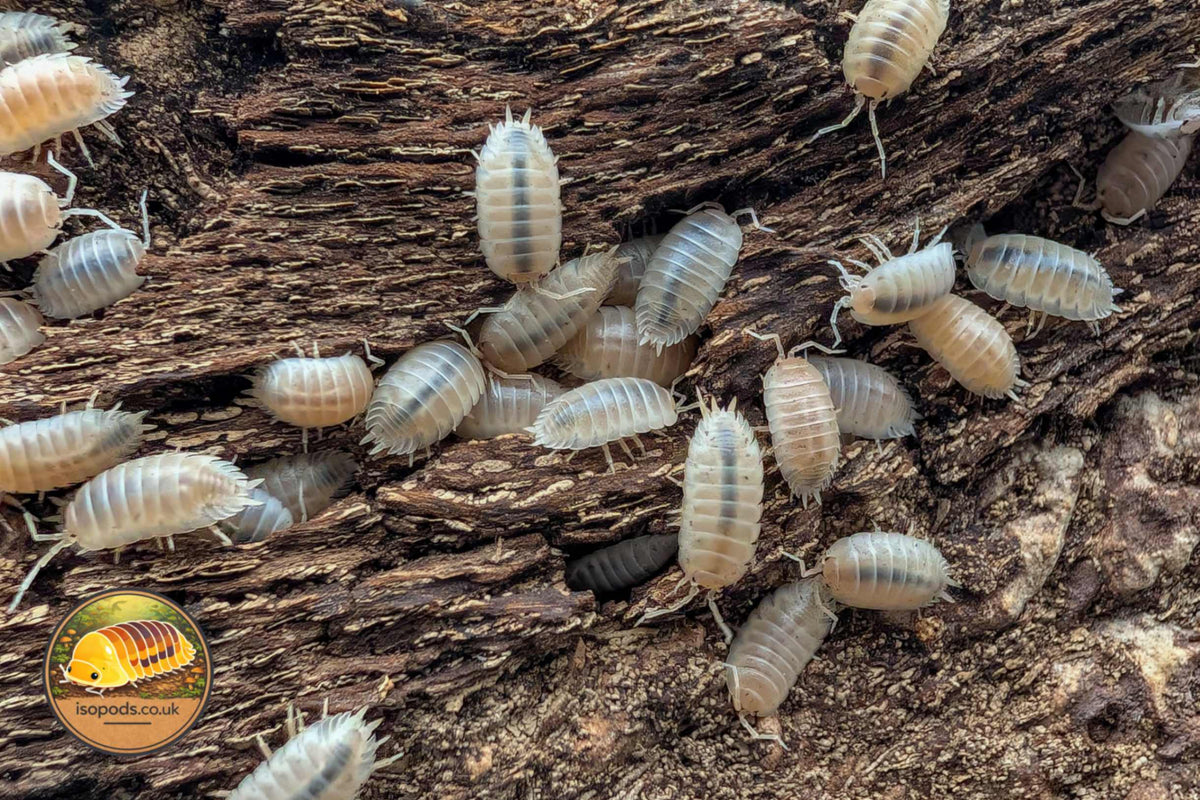
Porcellio laevis Snow White stands out for its clean pale look: a cream-white to snow-white laevis morph with a smooth dorsal surface and the larger, more solid body shape that makes laevis so popular. Against dark substrate, bark, and leaf litter, the pale colour shows up clearly, so this is a strong choice if you want a colony with bright contrast rather than a patterned black-and-white look.
In practical keeping terms, this is still very much a laevis-type Porcellio. Expect bolder movement, quicker feeding response, and more readable ground activity than you would usually get from quieter tropical genera. It suits keepers who want an enclosure that feels active, but it still needs proper airflow, heavy leaf litter, bark, rotting wood, steady calcium access, and a clear damp-to-drier layout.
A settled colony may spend time moving between leaf litter, bark edges, feeding spots, and the moist refuge instead of staying tucked into one hidden pocket all day. They are often easier to observe during feeding or evening checks, especially once the enclosure has enough cover for them to move without crossing too much bare ground.
If that open activity drops off and the whole colony compresses into one wet corner, the issue is usually setup balance rather than the species suddenly becoming secretive. In Porcellio, that often means the enclosure is too wet overall, too stale, or too exposed on the drier side. If you want broader genus context, the Porcellio care guide explains how airflow, shelter, and moisture choice affect behaviour.
Prepare an enclosure with a reliable damp refuge on one side and a drier but still usable side on the other. The drier side should not be bare. It should still have leaf litter, cover, and places to feed near shelter.
A thick layer of leaf litter should cover much of the surface, with pieces of cork bark for shaded undersides and hide edges. Add rot wood as part of the long-term food base, and keep limestone available for ongoing mineral support. If you need a refresher on setting up the moisture gradient itself, the isopod habitat setup guide is the best next read.
Like other isopods, this morph should be kept on a detritus-first diet. Leaf litter, mature substrate, and rotting wood should do most of the feeding work, with fresh foods and protein used as extras rather than the foundation.
Porcellio laevis often gives a quick visible response to supplements, but that can tempt keepers into overfeeding. If fresh foods sit too long, mould quickly, or sour the feeding area, reduce the amount and strengthen the litter and wood base instead.
This is a good match for buyers who want a pale, high-contrast isopod with more obvious feeding and movement than many tropical species. It can be especially appealing if you like watching colonies use the floor, litter, and bark in real time rather than only finding them under one hide.
It may be less satisfying if you want a very humid tropical setup style, or if you prefer highly patterned laevis morphs over a cleaner white look. It is also not a species to keep in a sparse tub and expect the best from; the colony still needs cover, food-rich surface layers, and a proper moisture gradient.
If you want to browse more of the same genus, start with the Porcellio isopods collection. If you are comparing pale Porcellio types, Porcellio scaber Ghost offers a useful contrast in body shape and general enclosure feel, while Porcellio expansus Orange Tortosa is worth a look if you want a more collector-leaning Porcellio with a very different overall look.