🔥 Daily Isopod Auctions on WhatsApp! Grab species at auction prices, discover rare finds & join our growing community. Join Here
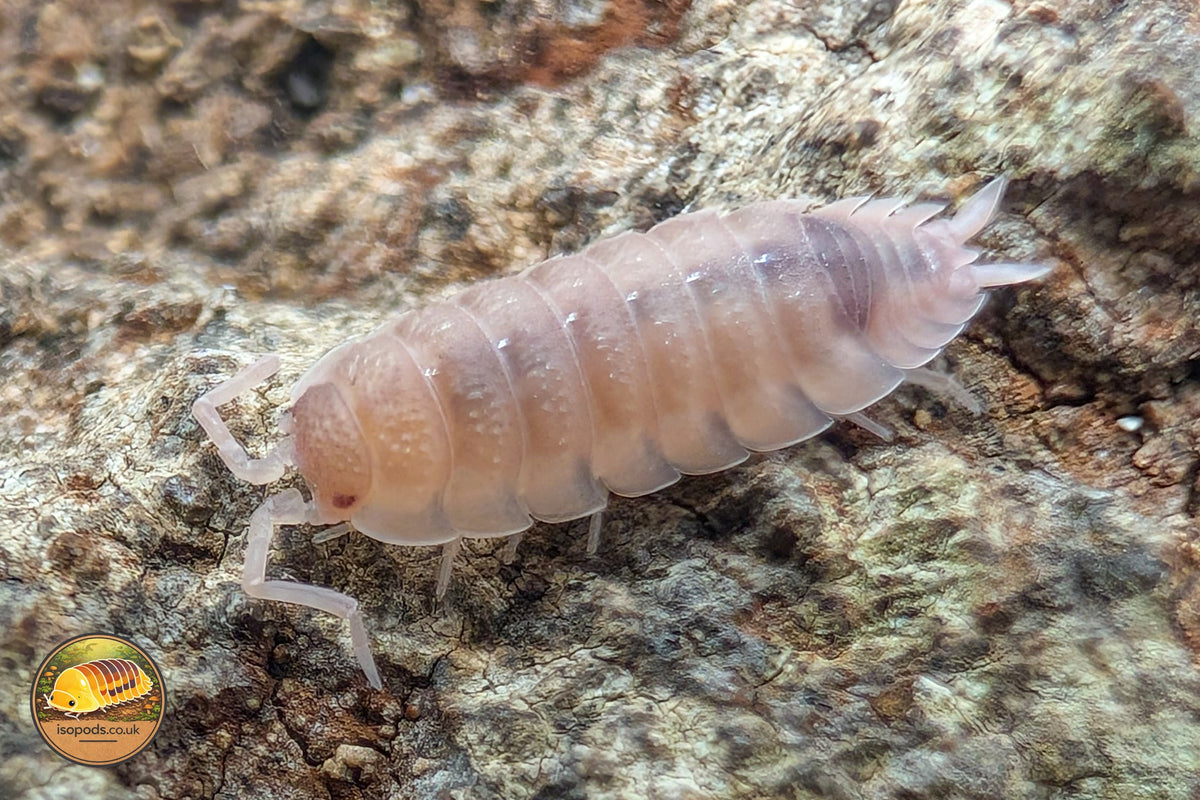
Porcellio scaber Ghost Isopod
20 in stock
Regular price
£5.00 GBP
Sale price
£5.00 GBP
Regular price
Unit price
per
Tax included.
Shipping calculated at checkout.
Couldn't load pickup availability
- Fully secure checkout
- Trusted by thousands
- Rated and reviewed
Want next day delivery? Be quick!
You just missed it!
Question about this product?
We're happy to help.
Porcellio scaber Ghost Isopods for Sale UK
Porcellio scaber Ghost stands out for its pale, reduced-pigment look on the classic rough scaber body. Depending on the line and the individual, you may see ghostly white, pale grey, mauve, yellowish-white, or slightly translucent-looking tones rather than one flat pure-white finish. That textured scaber surface gives this morph more character than a smoother pale isopod.
Beyond the colour, this is still very much a scaber in behaviour: active, practical, and easier to read on the ground than many hidden tropical species. If you want a pale Porcellio that still shows clear feeding response, makes use of bark and litter, and suits a ventilated enclosure with a damp refuge and drier side, Ghost is a strong option.
What makes Ghost different
-
Colour impression: pale reduced-pigment tones that can range from white and pale grey to mauve or yellowish-white. -
Texture: the familiar rough Porcellio scaber look, which makes the morph feel less flat than smoother light-coloured types. -
Behaviour: usually more ground-readable and food-responsive than many shelter-heavy tropical genera. -
Enclosure style: best in a setup with airflow, leaf litter, bark, decaying wood, calcium, and a clear moisture gradient.
How they usually behave
Ghost scabers are often seen moving around litter edges, bark, feeding areas, and the transition between the damp refuge and the drier side. They can be easier to observe than many tropical isopods, but they should not be treated as an exposed display animal that wants a bare tub. They still use cover well, and a colony usually looks better when it can move between sheltered spots instead of crossing open substrate all the time.
A settled colony often gives useful feedback: individuals appearing in more than one area, regular feeding around cover, and normal use of both the damper and airier parts of the enclosure. If everything stays packed into one wet corner, the rest of the tub may be too dry, too bare, or too stale.
Before you order
Have the enclosure ready with a proper detritus base rather than planning to add everything afterwards. A good starting point is deep enough substrate to hold moisture below the surface, a generous layer of rot wood and leaf litter for long-term grazing, bark or cork for shaded cover, and one damp refuge that stays moist without making the whole tub wet.
The rest of the enclosure should stay drier but still usable, with litter and hides in place rather than bare exposed floor. If you need a refresher on balancing airflow, moisture, and cover, the isopod habitat setup guide is the most useful setup reference before the colony arrives.
Setup that tends to work well
This morph suits the usual Porcellio scaber logic: fresh air, a reliable moist area, and plenty of floor space broken up with cover. Add bark pieces so they have shaded undersides and edges to sit against, and keep decaying wood and leaf litter available as part of the enclosure itself rather than treating fresh foods as the whole diet.
A moss pocket can help hold the damp refuge, and sphagnum moss is a practical way to keep one side reliably moist without turning the whole enclosure muddy. Calcium should also stay available at all times; limestone is a simple dry-side option.
Feeding notes
Like other scabers, they do best when the main food base is already built into the enclosure: leaf litter, decaying wood, mature substrate, and decomposing plant matter. Fresh foods can be offered in small amounts, but they should support the setup rather than replace it.
Because Porcellio often show a visible food response, it is easy to overfeed. Small portions are safer than repeated heavy feeding, especially if the enclosure is on the humid side. If you want a broader breakdown of staple diet versus extras, see what do isopods eat.
Who tends to enjoy this morph
This is a good fit for buyers who want a pale scaber with more day-to-day readability than a hidden tropical species. It suits keepers who enjoy seeing isopods around bark, litter, and feeding spots, and who prefer a practical ventilated setup over a wet tropical tub.
It may be less satisfying if your ideal colony is very hidden, heavily humidity-dependent, or kept in a sparse enclosure with little cover. It is also not the right choice if you expect every individual to be bright white, because Ghost lines can show a range of pale tones rather than one identical finish.
Compare before you decide
If you want to browse more of this genus, the Porcellio isopods collection is the clearest next stop. If you want another pale scaber comparison, Porcellio scaber Lemonade is worth viewing alongside Ghost. For broader genus-level care and troubleshooting, the Porcellio care guide explains how Porcellio setups differ from wetter tropical styles.
Ease of care
Preferred Temperature
Preferred Humidity
Popularity
Care Instructions
Care Instructions