🔥 Daily Isopod Auctions on WhatsApp! Grab species at auction prices, discover rare finds & join our growing community. Join Here
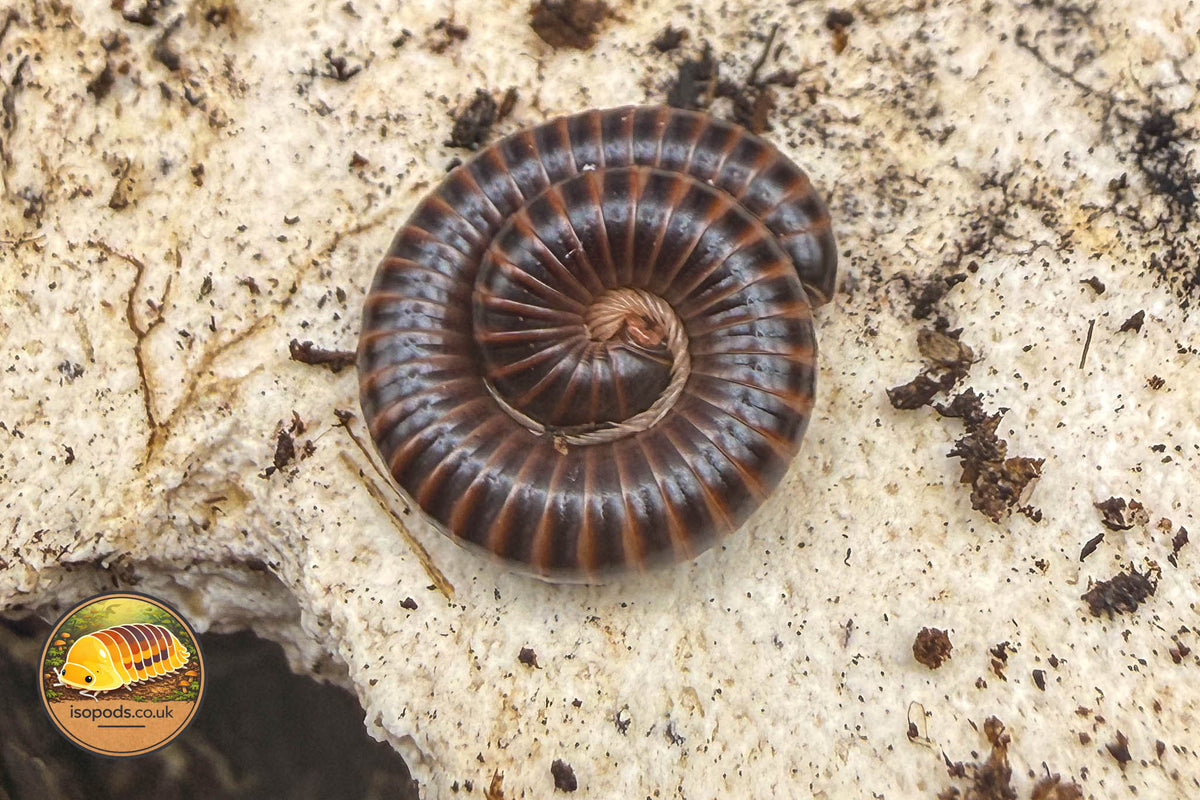
Leptogoniulus sorornus Millipede
Low stock! Only 10 left
Regular price
£12.00 GBP
Sale price
£12.00 GBP
Regular price
Unit price
per
Tax included.
Shipping calculated at checkout.
Couldn't load pickup availability
- Fully secure checkout
- Trusted by thousands
- Rated and reviewed
Want next day delivery? Be quick!
You just missed it!
Question about this product?
We're happy to help.
Leptogoniulus sorornus is a tropical millipede with a remarkably wide recorded distribution. Scientific literature describes it as a pantropical or tropical tramp species, with records from multiple parts of the world including Thailand and populations found in heated European tropical houses. That wide distribution is useful identification context, but it should not be taken to mean the species can be kept under any conditions.
Published information on L. sorornus is much stronger on taxonomy and distribution than on detailed captive husbandry. For that reason, we do not attach unsupported exact humidity, temperature, breeding-speed or visibility claims to this listing. Start with the substrate-led principles in our Complete Millipede Care Guide and prepare the enclosure before the animals arrive.
How does it compare with the Rusty Millipede?
The Rusty Millipede (Trigoniulus corallinus) is the most useful direct comparison on our site. Both species have extensive tropical records and the same general cylindrical millipede form, but they are distinct species and should not be treated as interchangeable simply because they can look similar at first glance.
Trigoniulus corallinus has stronger published biological and captive-study coverage, while the available literature for L. sorornus is weighted more towards identification, distribution and introduced populations. If you are deciding between them, use the Rusty listing and its Rusty Millipede Care Guide as useful comparison material without assuming that every species-specific detail transfers directly to L. sorornus.
Give the enclosure usable depth
Until stronger species-specific captive data is available, the sensible approach is to provide a mature, substrate-rich millipede enclosure with decaying organic material, leaf litter, stable moisture and sufficient airflow to avoid stagnant conditions. The substrate should give the animal genuine space below the surface rather than acting as a thin decorative layer. See How Deep Should Millipede Substrate Be? for the practical reasoning behind substrate depth.
For another visually different option, compare the Bumblebee Millipede, or browse the Small Millipedes collection to see other current choices.