🔥 Daily Isopod Auctions on WhatsApp! Grab species at auction prices, discover rare finds & join our growing community. Join Here
Filipinodillo Leopard Bee Isopod
Low stock! Only 1 left
Regular price
£95.00 GBP
Sale price
£95.00 GBP
Regular price
Unit price
per
Tax included.
Shipping calculated at checkout.
Couldn't load pickup availability
- Fully secure checkout
- Trusted by thousands
- Rated and reviewed
Want next day delivery? Be quick!
You just missed it!
Question about this product?
We're happy to help.
Filipinodillo Leopard Bee Isopods for Sale UK
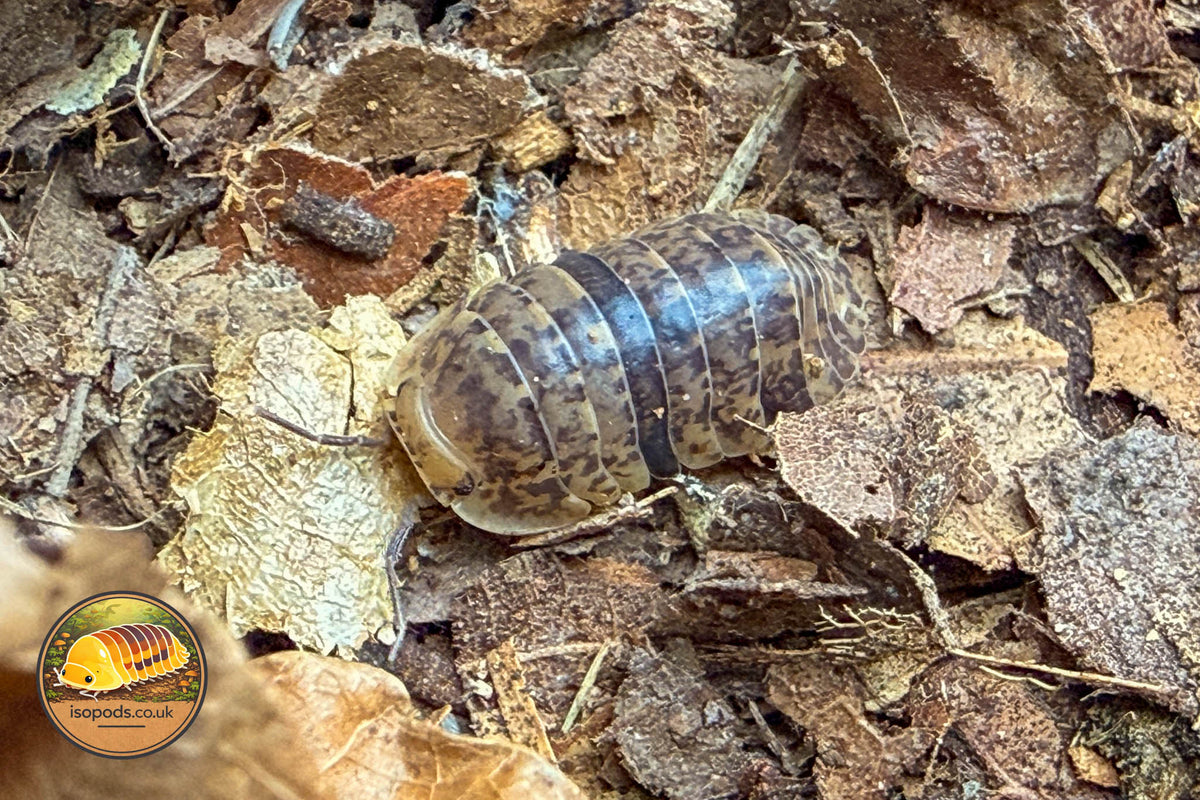
Filipinodillo Leopard Bee stands out for its mixed leopard-and-bumblebee look: bright amber to yellow tones broken up by dark spots, stronger solid bands, and a pattern that sits somewhere between speckled and striped rather than reading as a plain Bumblebee or straight Zebra type. It is a large, bold-looking Filipinodillo with real visual presence, so the appeal here is not just colour but colour carried on a more substantial body shape.
In enclosure terms, this is best treated as an active but still specialist tropical isopod. A settled colony may show useful movement around bark, leaf litter, and covered feeding areas, but it still needs humid conditions, a reliable damp refuge, and enough ventilation to stop the enclosure turning stale. If you want a striking Filipinodillo and you are happy to keep the moisture-and-airflow balance under control, Leopard Bee is an easy one to appreciate.
What makes Leopard Bee different
-
Pattern: a mixed spotted-and-banded look rather than a cleaner single-pattern style. -
Colour: bright amber or yellow tones contrasted with darker markings. -
Presence: a large Filipinodillo with a bolder look than smaller, quieter-looking forms. -
Behaviour: can be active around cover, but should still be treated as a more careful tropical setup species. -
Keeper appeal: strong choice for buyers who want both size and pattern rather than choosing one or the other.
Setup that suits them
Leopard Bee should be given more than a humid tub with one hide. Use deep substrate, a heavy layer of leaf litter, bark or wood cover, and sheltered feeding spots so they can move and graze without feeling exposed. Pieces of cork bark are especially useful for creating shaded undersides and tighter covered spaces.
Keep one area reliably damp, but do not make the whole enclosure wet. The rest of the tub should still have usable covered ground rather than bare dry patches. Rot wood helps with both shelter and long-term grazing, while steady access to limestone is a sensible way to keep calcium available. Strong ventilation matters here: humid is fine, stale is not.
How they usually behave
This is not a species to judge only by whether it sits out on open substrate. A healthy colony may spend time around bark edges, under cover, and in litter-rich areas, then appear more openly once settled and undisturbed. That gives you more visible feedback than very hidden tropical species, but it is still safer to expect cover-based activity rather than constant display behaviour.
If the whole colony ends up packed into one wet corner, the rest of the enclosure may be too dry, too bare, or too stale to use properly. If they retreat hard after rehousing or repeated checking, give them time and resist the urge to keep lifting every hide.
Before you order
- Prepare a humid tropical enclosure with a clear damp refuge and a drier but still covered side.
- Make sure bark, litter, and wood are already in place before the colony arrives.
- Avoid sparse tubs with exposed substrate across most of the floor.
- Plan for airflow as well as humidity; these should not be kept in a sealed wet box.
Feeding priorities
Like other isopods, Leopard Bee should be fed through the enclosure first. The main food base should come from litter, decomposing wood, and mature substrate, with fresh foods used as support rather than the foundation. If you are unsure how to balance core foods against supplements, what do isopods eat is a useful companion guide.
Quiet feeding under cover is normal. If they only seem interested when rich foods are offered, the enclosure may need more litter and wood rather than more treats.
Who tends to enjoy this species most
Leopard Bee makes most sense for keepers who want a visually bold Filipinodillo and are prepared to build around that with proper tropical cover, humidity, and ventilation. It suits buyers who enjoy seeing activity around bark and litter, not just on bare open substrate, and who do not mind that settling behaviour can still be cautious.
If your priority is a forgiving species for a simple sparse tub, or you mainly want constant open-floor movement, there are easier fits elsewhere.
Compare before you choose
If you want to stay within the genus, browse Filipinodillo isopods or compare Leopard Bee with the larger-bodied Filipinodillo R5 Giant. If you are choosing between bold tropical species more broadly, tropical isopods gives you a wider comparison set, and the isopod habitat setup guide is the best next step if you want to check your enclosure is ready before ordering.
Ease of care
Preferred Temperature
Preferred Humidity
Popularity
Care Instructions
Care Instructions