🔥 Daily Isopod Auctions on WhatsApp! Grab species at auction prices, discover rare finds & join our growing community. Join Here
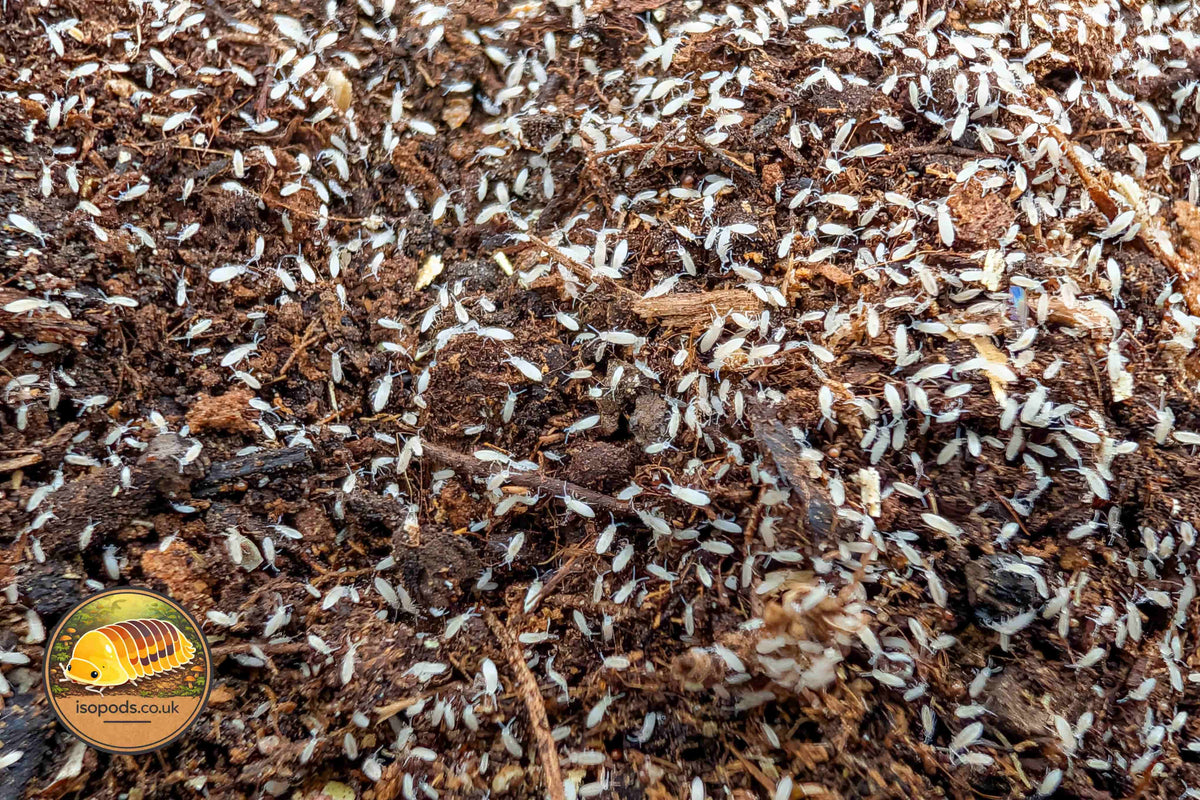
Tropical Springtails for Isopod Enclosures
41 in stock
Regular price
£5.00 GBP
Sale price
£5.00 GBP
Regular price
Unit price
per
Tax included.
Shipping calculated at checkout.
Couldn't load pickup availability
- Fully secure checkout
- Trusted by thousands
- Rated and reviewed
Want next day delivery? Be quick!
You just missed it!
Question about this product?
We're happy to help.
Tropical Springtails for Isopod Enclosures
This is a general tropical springtail culture in a 250 ml pot, chosen by keepers who want a simple clean-up crew addition for humid enclosures. It suits bioactive setups, isopod habitats and other damp environments where springtails can help support the microfauna layer.
Tropical springtails are usually kept for the way they fit into a living enclosure rather than for a fixed species identity or specialist role. The culture may contain small pale-cream, off-white or translucent springtails with slender bodies and long antennae, but exact appearance can vary with the stock and current culture.
They are best thought of as support animals in humid setups with airflow, rather than a replacement for maintenance. Springtails can help with smaller organic materials and microbial growth, but they still rely on sensible moisture and regular husbandry.
For most buyers, the main appeal is the broad pot format. It gives you a straightforward way to seed a humid enclosure without needing a counted culture or a specialist springtail type. If you are comparing options for a more specific look or use case, you may want to compare with Thai spikey springtails.
To use the culture, introduce it into a damp area of the enclosure with cover such as moss, leaf litter or other sheltered surfaces. A humid bioactive setup with some airflow is usually the right starting point. If the enclosure is very dry, sparse or newly set up, it is better to prepare the habitat first so the culture has somewhere suitable to settle.
Springtails are also commonly used alongside isopods because the two groups occupy different parts of the clean-up process. Isopods handle larger organic material, while springtails work in the finer, wetter microhabitats. Together they can make a more balanced bioactive community, especially when the enclosure has enough cover and organic material to support both.
Feeding the culture lightly can help maintain it, but food should match the size and activity of the population. Too much can create waste and unwanted mould, while too little may slow the culture down. In established bioactive enclosures, natural food sources often develop over time from fungi, biofilm and decaying organic matter.
If you are building a broader setup, this culture also fits naturally into a bioactive clean-up crew. For buyers who want to browse the wider range first, the main springtails for sale UK collection is the easiest place to continue.