🔥 Daily Isopod Auctions on WhatsApp! Grab species at auction prices, discover rare finds & join our growing community. Join Here
Orange Springtails for Isopod Enclosures
19 in stock
Regular price
£15.00 GBP
Sale price
£15.00 GBP
Regular price
Unit price
per
Tax included.
Shipping calculated at checkout.
Couldn't load pickup availability
- Fully secure checkout
- Trusted by thousands
- Rated and reviewed
Want next day delivery? Be quick!
You just missed it!
Question about this product?
We're happy to help.
Orange Springtails for Isopod Enclosures
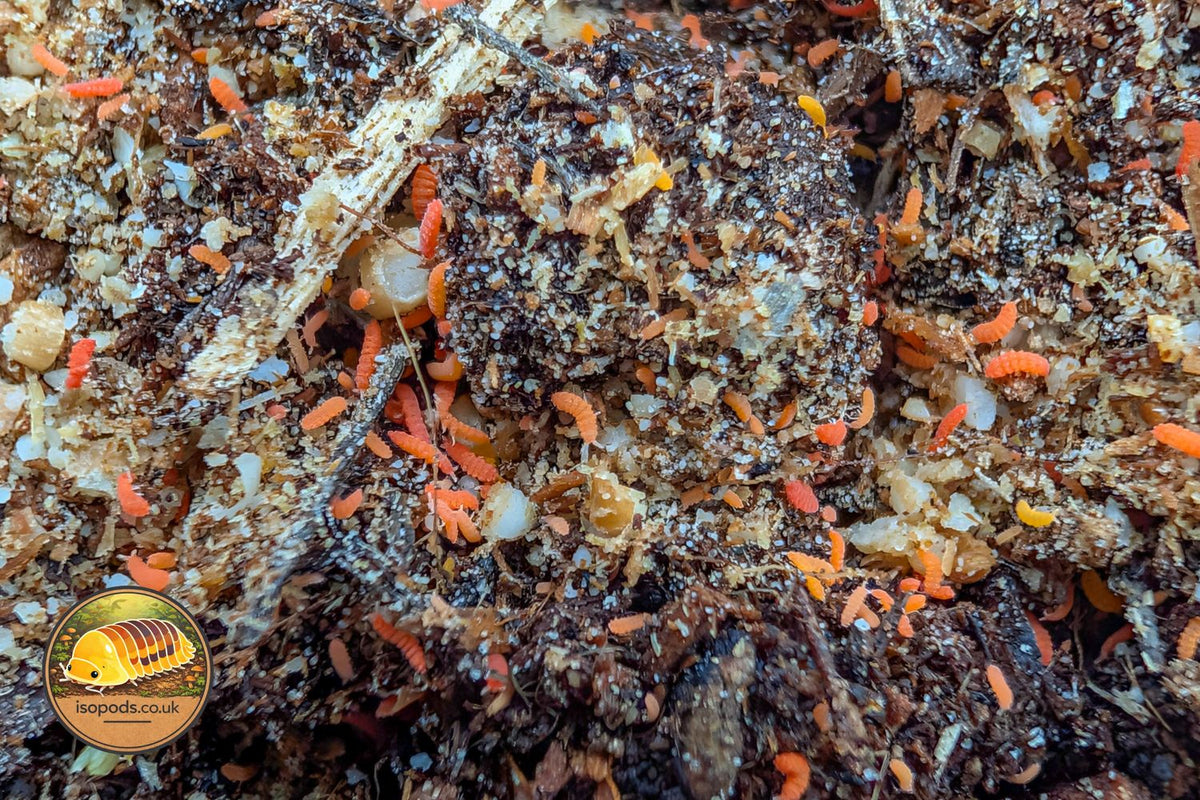
Orange springtails are a colour-led culture for buyers who want a visible springtail option in a 250 ml pot. They stand out for their orange to red-orange bodies, with a compact, plump shape that is easy to distinguish from slimmer springtail types. In the right setup, they can be a useful part of a damp bioactive enclosure alongside isopods.
The culture is intended for damp, humid environments with cover and air exchange. Introduce it into a setup that already has suitable moisture, leaf litter, moss or other sheltered surfaces, then let the population settle in naturally. Springtails are usually most useful where they can move through small damp spaces and feed on the fine organic material already present in the enclosure.
Visibility can vary. Orange springtails may appear pale peach-pink to blush in some lighting, and they are not always obvious at a glance. Their colour and activity can be easier to notice when the culture is dense enough and the substrate gives good contrast. Like other springtails, they are best treated as part of the enclosure's wider clean-up community rather than as a complete answer on their own.
For mixed bioactive setups, orange springtails can sit well with isopods. If you are building a broader clean-up crew, you may also want to compare them with springtails for sale UK or look at bioactive clean-up crew options. For a close colour comparison, you can also compare with pink springtails.
What arrives is a 250 ml springtail culture supplied as a pot culture. It suits buyers who want a coloured springtail option for a humid enclosure and prefer a straightforward culture rather than a specialist or counted product.