🔥 Daily Isopod Auctions on WhatsApp! Grab species at auction prices, discover rare finds & join our growing community. Join Here
Cubaris Orange Freeze Isopod
Low stock! Only 1 left
Regular price
£17.50 GBP
Sale price
£17.50 GBP
Regular price
Unit price
per
Tax included.
Shipping calculated at checkout.
Couldn't load pickup availability
- Fully secure checkout
- Trusted by thousands
- Rated and reviewed
Want next day delivery? Be quick!
You just missed it!
Question about this product?
We're happy to help.
Cubaris Orange Freeze Isopods for Sale UK
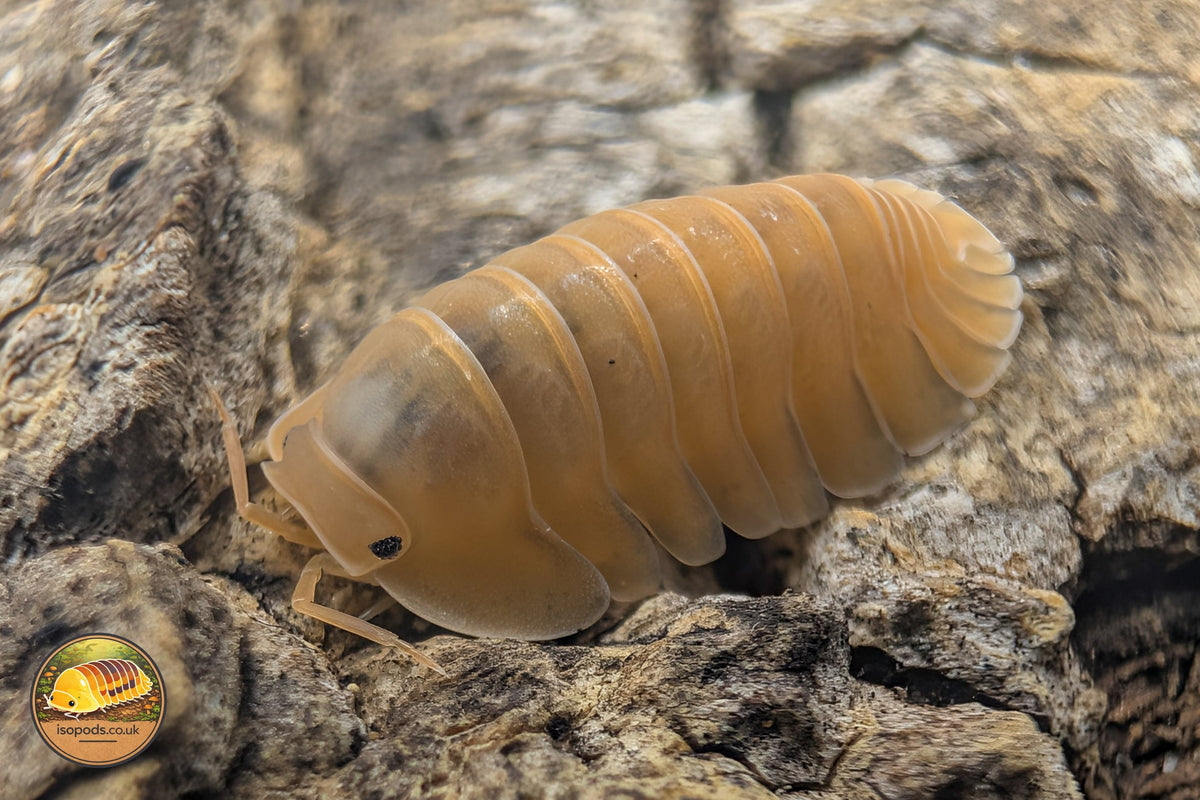
Cubaris Orange Freeze stands out for its unusual colour contrast: warm yellow-orange to fiery orange highlights set against paler, frosted tones, with a semi-translucent look around the body edges that gives this morph its frozen-orange character. It has a more chilled, glassy finish than many standard orange Cubaris, which is what makes it so striking in a settled colony.
In practical keeping terms, this is still a Cubaris type best treated as humid, cover-focused, and better for patient observation than constant display. Expect most activity around bark, leaf litter, rotting wood, and sheltered damp areas rather than regular open-floor roaming.
What makes Orange Freeze different
-
Colour impression: bright orange to yellow-orange highlights with paler, frosted-looking tones. -
Edge detail: the body margins can appear lightly translucent, giving a cold, glazed effect. -
Overall look: more icy and washed with frost than a flatter solid-orange Cubaris look. -
Viewing style: usually most appreciated when found under bark, along cover edges, or in shaded feeding spots.
How they usually behave
Orange Freeze are usually found under cover rather than out on bare substrate. A settled colony may spend long periods under bark, inside deeper leaf litter, around decaying wood, or close to the damp refuge. That is normal for many Cubaris and should not be treated as a problem on its own.
A healthier sign is not constant visibility, but whether the colony uses more than one sheltered area over time. If animals are found under different hides, leaf litter is gradually wearing down, and the enclosure smells fresh and earthy, quieter behaviour is often just normal Cubaris behaviour. If nearly everything stays compressed into one wet corner, the rest of the enclosure may be too dry, too exposed, or too stale to use.
Before you order
Prepare the enclosure as a humid tropical setup with deep substrate, heavy cover, and a clear damp refuge before the colony arrives. Orange Freeze are better suited to a mature, well-layered tub than to a sparse box with one wet patch.
A useful setup usually includes a deep base of organic substrate, plenty of leaf litter, pieces of cork bark for shaded undersides and tight hiding spaces, decaying wood, and a damp moss pocket made with sphagnum moss. Keep one area reliably moist, but do not soak the whole enclosure. These isopods usually do better with humid shelter and some airflow than with either a fast-drying exposed tub or a sealed wet one.
Feeding and mineral support
Like other Cubaris, Orange Freeze should be treated as detritus-first. The main food base should come from leaf litter, rotting wood, and mature substrate rather than frequent rich feeding. Fresh foods can be offered in small amounts, but they are extras rather than the foundation.
Steady calcium access is worth providing, and limestone is a practical option. If you are building the enclosure from scratch or want to tighten your feeding approach, the Cubaris care guide is the most useful next read.
Who tends to enjoy this species most
Orange Freeze makes the most sense for keepers who like collector-style Cubaris with a distinctive finish and are happy to enjoy them in glimpses around bark, litter, and covered feeding spots. It suits buyers who can keep a dependable damp refuge, maintain plenty of cover, and avoid overchecking a new colony.
If you mainly want bold open activity or fast visual feedback from feeding, another genus may be easier to read. This morph is better chosen for its look and quieter enclosure use than for constant movement in the open.
Compare before you choose
If the frozen edging and orange glow are what draw you in, browse more Cubaris isopods to compare nearby styles. If you want a related orange-toned comparison with a stronger edge-focused look, see Cubaris Red Edge Orange. If you are still deciding between tropical hidden species and broader browsing options, you can also explore tropical isopods or view all isopods.
Ease of care
Preferred Temperature
Preferred Humidity
Popularity
Care Instructions
Care Instructions