🔥 Daily Isopod Auctions on WhatsApp! Grab species at auction prices, discover rare finds & join our growing community. Join Here
Porcellio bolivari "Lemonade" Isopod
Low stock! Only 4 left
Regular price
£22.50 GBP
Sale price
£22.50 GBP
Regular price
Unit price
per
Tax included.
Shipping calculated at checkout.
Couldn't load pickup availability
- Fully secure checkout
- Trusted by thousands
- Rated and reviewed
Want next day delivery? Be quick!
You just missed it!
Question about this product?
We're happy to help.
Porcellio bolivari "Lemonade" Isopods for Sale UK
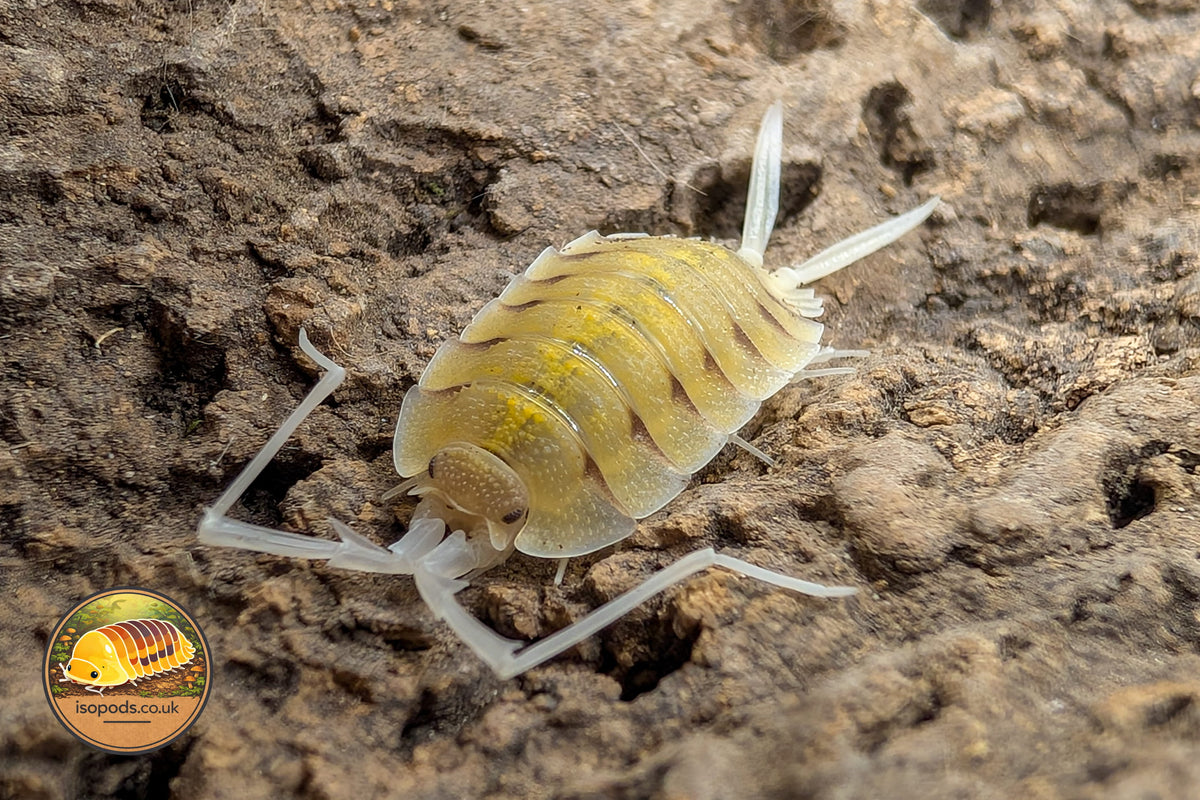
Porcellio bolivari "Lemonade" stands out for its brighter lemon-yellow look, reduced dark pigment, and a clear yellow stripe running over that long, almost skeleton-like bolivari shape. If you want a large Spanish Porcellio with stronger visual impact than a standard grey form, this is the appeal.
In the enclosure, this morph is often more readable than hidden tropical species. Once settled, it may be seen moving along bark, leaf litter, and feeding spots, especially when the setup gives it space, strong airflow, and a proper moisture gradient instead of a uniformly wet tub.
What makes Lemonade different
-
Colour: brighter lemon and yellow tones with reduced darker pigment. -
Pattern: often noted for a yellow dorsal stripe that helps the morph stand out. -
Shape: the stretched, skeletal-looking Porcellio bolivari build gives it a very distinct outline. -
Presence: a large Porcellio type that suits keepers who enjoy bolder enclosure movement and a more substantial animal to observe. -
Origin context: a Spanish Porcellio, with eastern Spain relevant to how many keepers frame this type.
How they usually behave
This is better approached as an active, surface-readable Porcellio than as a hidden tropical species. They can make regular use of bark edges, litter cover, open feeding areas, and the transition between the drier side and the moist refuge, rather than spending all their time buried out of sight.
That does not mean constant display. After shipping, rehousing, or disturbance, they may hide more at first. A healthy settled setup is usually easier to read when individuals are using more than one covered area, feeding without all packing into one wet corner, and moving between the drier side and the damp refuge with confidence.
Setup that suits this morph
Porcellio bolivari "Lemonade" is best prepared for as a spacious, well-ventilated Porcellio setup. Give them a generous layer of leaf litter, bark or cork hides, and enough floor area to move properly rather than forcing the colony into one cramped shelter.
The key is choice. Keep one side reliably moist below the surface, but leave a broader drier area that still has cover. A slab of cork bark works well for creating shaded undersides and covered edges between the damp and drier zones. Avoid keeping the whole tub wet. Porcellio often behave less naturally when there is no usable dry ground and the enclosure turns stale.
If you want a broader breakdown of airflow, feeding response, and moisture balance before ordering, the Porcellio care guide is the best next read.
Before you order
Have the enclosure ready with cover already in place, not just bare substrate and a single wet corner. This morph makes more sense in a setup with bark, litter, fresh air, a dependable damp refuge, and room to spread out. If most of the tub is exposed or wet from end to end, you are less likely to see the active, readable behaviour people usually want from Porcellio.
A long-term food base matters too. Add some rot wood and keep calcium available with limestone so the enclosure supports grazing and mineral access from the start, rather than relying only on fresh foods afterwards.
Who tends to enjoy this species most
This morph is a good fit for keepers who want a bold-looking Porcellio with strong yellow tones, larger presence, and behaviour that is often easier to observe than many sheltered tropical isopods. It also suits buyers who prefer ventilated setups with a clear dry-to-moist pattern rather than uniformly humid tubs.
It may be less satisfying if you mainly want a colony that tolerates sparse, wet setups, or if you prefer very hidden tropical species that spend most of their time under deep cover. It is also a poorer match for buyers expecting constant visibility without giving the colony space, bark, litter, and airflow.
Compare before you choose
If you are comparing similar Porcellio, Porcellio echinatus "Red Edge" is a useful contrast within the genus. If you want something larger-bodied in a different style, Porcellio laevis Giant Orange is another strong comparison. You can also browse the wider Porcellio isopods range to compare body shape, colour direction, and enclosure style before deciding.
Ease of care
Preferred Temperature
Preferred Humidity
Popularity
Care Instructions
Care Instructions